
ExamPlay Light Logo
Đăng nhập

JEE Advance - Physics (2014 - Paper 2 Offline - No. 17)

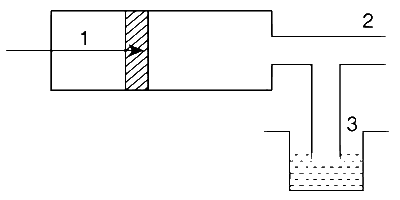
A spray gun is shown in the below figure where a piston pushes air out of a nozzle. A thin tube of uniform cross-section is connected to the nozzle. The other end of the tube is in a small liquid container. As the piston pushes air through the nozzle, the liquid from the container rises into the nozzle and is sprayed out. For the spray gun shown, the radii of the piston and the nozzle are 20 mm and 1 mm, respectively. The upper end of the container is open to the atmosphere.

A spray gun is shown in the below figure where a piston pushes air out of a nozzle. A thin tube of uniform cross-section is connected to the nozzle. The other end of the tube is in a small liquid container. As the piston pushes air through the nozzle, the liquid from the container rises into the nozzle and is sprayed out. For the spray gun shown, the radii of the piston and the nozzle are 20 mm and 1 mm, respectively. The upper end of the container is open to the atmosphere.

A spray gun is shown in the below figure where a piston pushes air out of a nozzle. A thin tube of uniform cross-section is connected to the nozzle. The other end of the tube is in a small liquid container. As the piston pushes air through the nozzle, the liquid from the container rises into the nozzle and is sprayed out. For the spray gun shown, the radii of the piston and the nozzle are 20 mm and 1 mm, respectively. The upper end of the container is open to the atmosphere.

If the density of air is $$\rho$$a and that of the liquid $$\rho$$l, then for a given piston speed the rate (volume per unit time) at which the liquid is sprayed will be proportional to
$\sqrt{\frac{\rho_a}{\rho_{\ell}}}$
$\sqrt{\rho_a \rho_{\ell}}$
$\sqrt{\frac{\rho_{\ell}}{\rho_a}}$
$\rho_{\ell}$

Giải thích

For horizontal flow, Bernoulli's theorem becomes

$${P \over \rho } + gh + {1 \over 2}{v^2} = k'$$

$$P + {1 \over 2}\rho {v^2} = k$$ (h = 0)

Between points 1 and 2 :

$${P_1} - {P_2} = {1 \over 2}{\rho _a}v_a^2$$
JEE Advanced 2014 Paper 2 Offline Physics - Properties of Matter Question 20 English Explanation

Between points 2 and 3 :

$${P_3} - {P_2} = {1 \over 2}{\rho _l}v_l^2$$

Since, P1 = P3, we have

$${1 \over 2}{\rho _l}v_l^2 = {1 \over 2}{\rho _a}v_a^2$$

$${{{v_l}} \over {{v_a}}} =\sqrt {{{{\rho _a}} \over {{\rho _l}}}} $$

Bình luận (0)

Đăng nhập để bình luận
Quảng cáo
BrainBehindX Inc Logo
©2026; Được cung cấp bởi BrainBehindX Inc